Having a product idea and finding someone who can make it are two different challenges. You might know exactly how the finished product should look, yet still be unsure which type of factory to contact, what information it will need or whether your first order is large enough to interest anyone.
This is where many product businesses lose time. They send a brief description to a long list of companies, receive a mixture of silence and very different prices, and find it difficult to judge what those responses mean. Sometimes the problem is the supplier search. Sometimes the product needs more development before a manufacturer can give a useful answer.
The right manufacturer fits both your product and the stage your business has reached. A company that can produce an item is not automatically the right partner to develop it, make a small first batch or support the quality requirements of your intended market.
This guide explains how to work out what help you need, translate your product into a manufacturing brief, find suitable candidates and move towards a first production order with fewer unanswered questions.
Work out how close your product is to production
Before looking for a factory, take an honest look at what you already have. An idea, a sketch, a working prototype and a production-ready design give a manufacturer very different starting points.
If you have an idea but have not resolved the design, materials or construction, you may need a product designer, engineer or development partner first. Some manufacturers offer these services, but others expect to receive a specification they can manufacture without substantial design work.
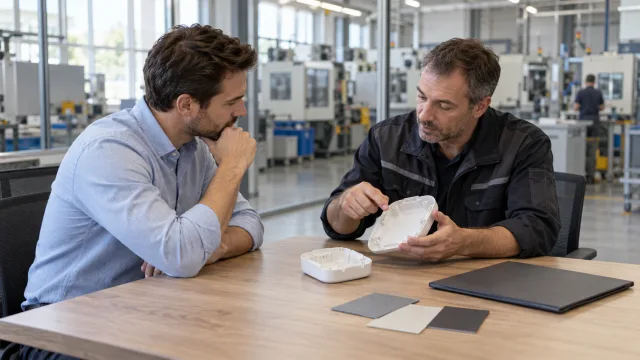
A working prototype is a useful step forward, although it does not necessarily mean the product is ready for repeat production. A handmade sample might use techniques that are too slow for a batch. A 3D-printed housing might demonstrate shape and function while still needing changes for another production process.
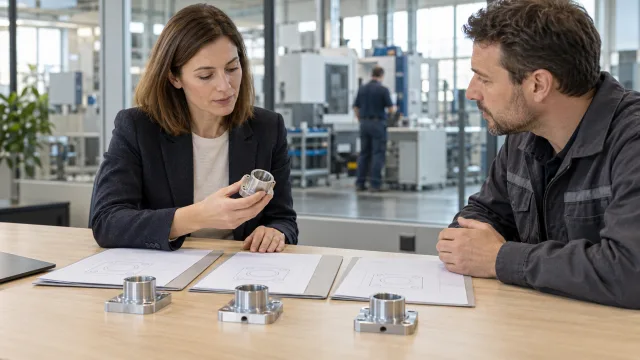
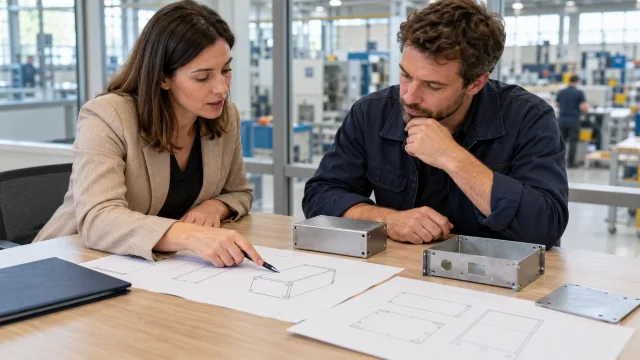
Even an apparently finished design can leave important questions open. How will the parts be joined? Which dimensions are critical? What finish is required? How will the product be inspected, packed and tested? A manufacturer needs enough of these details to assess the work and understand what an acceptable result looks like.
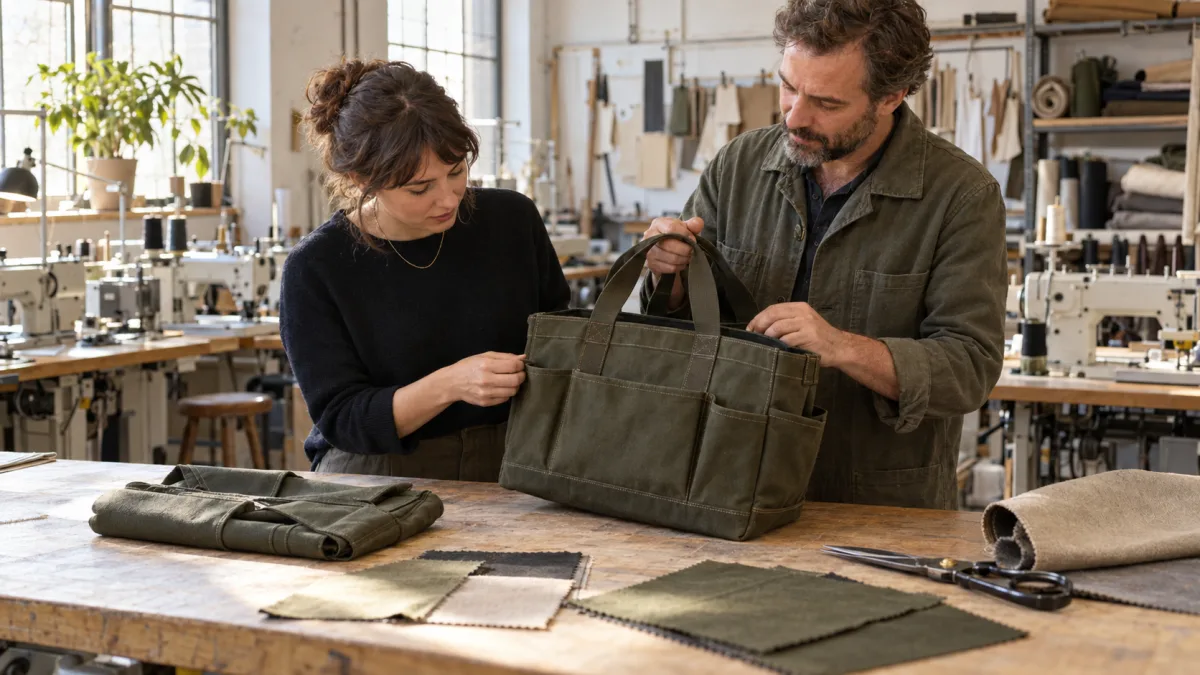
Write down what is decided, what still needs advice and who you expect to resolve it. For example, you may have fixed the external dimensions of a bag but still need help choosing fabric and construction methods. That is a workable development enquiry, provided you describe it as one.
Being clear about your stage avoids expecting a firm production price from a company that would first need to carry out weeks of development.
Decide what you want the manufacturer to do
Your next task is to define the supplier's role. Do you need a business to make a finished product, produce one component, assemble parts from several sources or supply an existing item with your branding?
For a fully custom product, a manufacturer may work from your drawings, patterns, formulation or other specifications. The more complete those inputs are, the easier it becomes to discuss production. If the supplier will also develop the design, agree the development work and deliverables separately from the eventual manufacturing order.
Private label production can be a different starting point. You may select an existing product and customise its branding, packaging or certain features. This can reduce the amount of development required, although you should establish which changes are possible and whether the resulting product will be exclusive to you.
Some products need several specialist suppliers. An electronic device might involve a circuit board, a housing, cables, assembly and testing. A furniture product might need woodworking, metal fabrication and upholstery. You can coordinate those businesses yourself or look for a partner that manages the complete build.
A supplier offering a complete service may simplify coordination, but ask which work it performs in-house and how it controls outsourced operations. If you manage separate suppliers, think carefully about who takes responsibility when the finished parts do not fit or function together.
The choice should reflect your experience and available time. A lower component price is less useful if your business cannot manage the engineering, purchasing and assembly needed to turn those components into a saleable product.
Turn the idea into a useful product brief
A product brief connects your idea with a manufacturer's practical questions. It does not have to be lengthy, but it should make the intended product and the requested work understandable.
Begin with what the product does and who will use it. Explain the conditions it needs to withstand and the features that matter most. A bag for occasional shopping has different requirements from one intended to carry heavy tools every day, even if their dimensions are similar.
Then describe the physical product. Include dimensions, materials where known, colours, finishes and construction details. Reference photographs or an existing sample can help explain your intentions, but identify exactly what they illustrate. A photograph alone rarely establishes material quality, internal construction or permitted dimensional variation.
Make essential requirements distinguishable from preferences. If the product must fit inside an existing cabinet, certain dimensions may be fixed. If the colour is still open, say so. This gives the manufacturer room to suggest practical changes without accidentally altering something that cannot change.
State your first-order quantity, expected delivery destination and proposed timetable. Describe potential repeat demand separately. A forecast is useful context, but it should not be presented as a commitment unless you can make one.
Packaging and presentation belong in the brief as well. Individual retail boxes, labels, instructions and protective packaging can affect both cost and the work required. If your product needs particular tests or documents, raise those requirements before the quotation is prepared.
Keep one current version of the brief and supporting files. When the design changes, update the revision and tell each supplier what has changed. Otherwise, apparently competing quotations may refer to different products.
Match the product to suitable manufacturing capabilities
A product name does not always tell you which manufacturer to search for. Factories often describe themselves by materials, processes or services rather than the exact item you want to sell.
For a fabric bag, you might search for industrial sewing, sewn products or bag manufacturing. For a wooden desk accessory, relevant terms could include woodworking, CNC routing or wooden product manufacturing. For an electronic product, you may need electronics assembly alongside enclosure manufacturing.
If several processes could work, explain the required result and ask suppliers to discuss the options. The best production route may depend on quantity, shape, material and performance. A method suitable for an initial batch might be different from the one you would use after demand grows.
This is particularly important when a process requires dedicated tooling. Before committing to that route, establish whether a simpler initial method could produce an acceptable product for market testing. Also ask what would need to change if you later switched to higher-volume production.
Look for evidence of comparable work rather than an exact match to your product. A manufacturer may never have made your particular organiser but may have extensive experience with similar fabrics, seams and load-bearing construction. That experience can be relevant if it understands your requirements.
Where function or safety depends on technical decisions you cannot assess, involve a suitable specialist. Manufacturer input can be valuable, but you still need a clear basis for deciding whether the proposed design meets your needs.
Search for suppliers whose production model fits yours
Once you understand the likely capabilities, begin researching companies. You can use LocalSuppliers.eu to discover potential European manufacturing partners, then investigate their websites and discuss your project directly.
For a wider explanation of search routes, country selection and supplier research, see our guide to how to find manufacturers in Europe. For a particular product, keep the search focused on what each company can contribute to the build.
Manufacturer directories, industry associations and trade fair exhibitor lists can all provide candidates. Recommendations from designers or engineers are also useful when the recommended company has handled work similar to yours.
As you research, ask whether your order would fit the factory's normal operations. A business organised around large, standardised runs may find a small custom batch difficult to accommodate. Another supplier may specialise in development and low-volume production but become less competitive at larger quantities.
Look beyond statements such as “we work with businesses of all sizes”. Ask about normal batch sizes, development services, material purchasing requirements and how smaller orders are scheduled. These details reveal more than a general promise of flexibility.
Location should support the practical needs of the project. During development, easy visits and timely discussions may be valuable. For bulky finished goods, delivery arrangements may carry more weight. Compare those factors alongside capability rather than choosing a country before understanding the production work.
Record promising suppliers in one place, including the evidence that makes them relevant. Keep unconfirmed claims marked as questions until the company has answered them.
Check your budget and quantity before requesting firm prices
A manufacturer needs a commercially workable order, and you need a product that makes sense for your business. Those requirements meet in the relationship between development costs, setup work, batch size and unit price.
Minimum order quantities can arise for different reasons. A factory may need to buy a minimum amount of material, meet a subcontractor's batch requirement or spread setup time over enough units. Ask what drives the minimum instead of assuming it is an arbitrary rule.
Sometimes a smaller order is possible at a higher unit price. Sometimes reducing the number of colours, sizes or packaging variations makes the order easier to produce. In other cases, the production route is simply unsuitable for your volume.
Be careful when comparing the cost of an initial run with repeat production. In an illustrative example, 500 products at €8 each plus a €1,500 development charge cost €5,500 before other charges. Another supplier offering €10 per product with the same development work included would total €5,000. The first offer could become more attractive over repeat orders, but only if the charges and specifications are genuinely comparable.
Work backwards from the price your business can realistically achieve. Allow for packaging, delivery, selling fees, returns, storage and other relevant costs, rather than treating the factory price as your complete cost. If the numbers do not work, address that before paying for development or tooling.
Ask suppliers which changes could reduce cost without undermining the product. They may identify an unnecessarily difficult feature, a less practical material specification or too many variations. Assess each suggestion against what customers actually need.
Approach manufacturers with a clear first enquiry
The first enquiry should help the manufacturer decide whether to explore the project. Lead with the product, stage of development and requested service. A long introduction to your brand can wait until the company understands the work.
For example: “We are developing a fabric tool organiser for professional users and are looking for a supplier that can help finalise the construction and produce an initial batch of 500 units. We have a sample and approximate dimensions, but would like advice on fabric selection and reinforcement. Delivery would be to Lithuania. Is this a project you could support, and what would you need to assess it?”
This gives the supplier a clearer starting point than asking how much it would cost to make a bag. It also distinguishes development support from straightforward production.
If you have finished specifications, provide the information needed for a technical assessment and identify the file revisions. If information is missing, acknowledge it and ask what work is required before a reliable quotation can be prepared.
Request answers to the uncertainties that matter: whether the product and volume fit, which work the company would undertake, what development it expects and how it would approach sampling. You do not need every commercial detail settled in the first exchange.
When a reply exposes an omission in your brief, update the other suppliers too. Keeping the information consistent makes later comparison much easier.
A thoughtful response may include questions or reservations. Those can be useful signs that the company is examining the project seriously. If a supplier declines, ask whether the difficulty is the quantity, process, design stage or timetable. That answer can help improve your next enquiry.
Verify the supplier and agree how information will be shared
Before moving into detailed development, confirm the legal entity you would contract with and the facility involved in the work. Check the registered company information against the quotation and establish whether you are dealing with the producer, an agent or a business coordinating several suppliers.
Ask for relevant examples of production, discuss the proposed process and consider a video call, site visit or independent assessment where the value and complexity justify it. Evidence should relate to your requirements. A polished website and a list of machines cannot establish how a particular order will be managed.
Where certifications are relevant, examine their scope and the site they cover. IAF CertSearch can help check accredited management system certification records. Resolve discrepancies with the supplier and issuing body, and assess product-specific testing and documentation separately.
Think about confidentiality before sharing commercially sensitive information. You can often begin by describing the type of product and work without disclosing every design detail. Share the fuller information when the company appears suitable and appropriate arrangements are in place.
The World Intellectual Property Organization's introduction to trade secrets explains the role of reasonable measures to keep valuable information confidential, including confidentiality agreements. Use it as background when considering how to handle sensitive designs, formulas or processes.
A confidentiality agreement does not answer every ownership question. If the manufacturer will create drawings, patterns, software or other development outputs, agree who can use them and what you will receive. Discuss the ownership and transfer of tooling as well. For a commercially significant arrangement, have the terms reviewed before relying on them.
Use sampling to resolve questions before production
Sampling should have a clear purpose. You may need to prove that the product works, compare materials, assess appearance or confirm that the intended production process can meet your specification. Those are related tasks, but one sample may not answer them all.
For a sewn product, an early sample might establish dimensions and construction before final fabric and colours are selected. For a moulded item, an early prototype might help assess shape while later samples are needed to assess parts made using production tooling.
Ask how representative each sample will be. If it uses different materials or methods from the proposed production batch, record those differences and identify what remains to be checked.
Agree the number of development rounds, their cost and what happens if a sample does not meet the brief. Clarify which revisions are included and which would create additional work. Otherwise, sampling can turn into an open-ended process without a clear route to approval.
Assess the product in the conditions that matter to its intended use. A tool organiser may need evaluation of its seams, closures, usable capacity and performance under the expected load. The appropriate tests depend on the design and application, so decide the criteria before approving the result.
Document approved changes and keep the reference sample linked to the current specification. Approval should establish what is accepted and what still needs attention. Avoid moving into production while important questions remain hidden behind an informal “looks good”.
Confirm the complete offer before placing your first order
By this point, you should be comparing proposals for a defined product, not competing interpretations of an idea. Confirm that the quotation reflects the approved specification, quantity, materials, finish and packaging.
Review the whole commercial arrangement. Establish which charges are one-off, what the recurring price includes, when payments are due and what must happen before production begins. Clarify the delivery basis and the difference between goods being ready to ship and arriving at your destination.
Allow time for the steps between appointment and delivery. Development, material purchasing, tooling, sample review and production scheduling may all affect the timetable. Ask for a schedule with clear approval points so your own decisions do not unexpectedly hold up the order.
Agree how quality will be assessed and how problems will be handled. Discuss inspection, acceptable variation, defective goods and changes to the product. For a first run, consider whether a controlled initial batch would give you a useful opportunity to assess consistency before increasing volume.
Choose the manufacturer whose proposal you can understand and whose approach fits your business. Its ability to make the item matters, but so does its ability to turn approved samples into consistent deliveries and communicate when something changes.
You can begin researching candidates through LocalSuppliers.eu. Bring a clear brief, an honest first-order quantity and a description of the support you need. Those details make it easier to find a manufacturer that suits the product you want to build and the business you are building around it.
Frequently asked questions
Can I find a manufacturer if I only have an idea?
Yes, but you may need development help before production can be quoted accurately. Look for a manufacturer offering relevant design support, or work with a product designer or engineer first. Explain what is already decided and what you need the partner to develop.
Do I need a prototype before contacting manufacturers?
Not always. A clear brief and suitable drawings may be enough for an initial assessment. A prototype can help demonstrate the intended function, but it may still need changes for repeat production. Ask suppliers what evidence they need to evaluate your particular product.
How do I find a manufacturer willing to accept a small order?
Search for businesses offering low-volume, small-batch or development work, then confirm that your quantity fits. Ask what drives their minimum order and whether fewer variations or another production route would help. A smaller batch may carry a higher unit price.
Should I use a custom manufacturer or a private label supplier?
Custom manufacturing may suit a product that needs a distinctive design or specification. Private label supply may suit a business that can start with an existing product and agreed modifications. Compare the development work, available customisation, ownership arrangements and commercial terms.
Can one manufacturer make my entire product?
Sometimes. Some companies manufacture and assemble a complete product, while others specialise in one process or component. Ask which operations happen in-house, which are subcontracted and who controls the quality of the finished product.
How much does it cost to have a product manufactured?
The cost depends on the design, materials, process, quantity, development work, tooling and testing requirements. Request quotations against a consistent brief and separate initial charges from recurring costs. Include packaging and delivery when assessing the amount you will need to spend.
Should I ask a manufacturer to sign an NDA?
Consider appropriate confidentiality arrangements before sharing sensitive information. You can usually begin with a general project description while assessing fit. An NDA should be considered alongside how information is shared and who owns the development work, rather than assumed to resolve every issue.
Who owns the drawings and tooling a manufacturer creates?
Establish this in the agreement before commissioning the work. Discuss ownership, permitted use, access to files, tooling storage and whether items can be transferred to another supplier. Payment alone should not be treated as a complete answer to those questions.
What if no manufacturer will accept my product?
Ask why. The obstacle could be the quantity, cost target, incomplete specification, technical requirements or deadline. Use that feedback to reconsider the brief, development stage or production route before continuing the search.
How do I know when I am ready to place the first order?
You should have an agreed specification, a clear quotation, appropriate sample approval or other validation, and confirmed quality and delivery arrangements. Resolve important questions about development outputs, tooling and payment before authorising production.